Governance
JCIS Board of Directors & Auditor
Chair: Matthew Parr – Nagoya International School
Vice-Chair:: James Moore – Montessori School of Tokyo
Treasurer: Annette Levy – Saint Maur International School
Communications: Megan Roe – Okinawa Christian School International
Director: David Mawhinney – Christian Academy in Japan
Director: Kurt Mecklem – Osaka International School of Kwansei Gakuin
Director: Colette Rogers – Seisen International School
Director: Matt Topliss – Kyoto International School
Ex-officio Director: Bob Pomeroy – JCIS COO
Auditor: Cathy Endo
JCIS Constitution
ARTICLE I: Name and Definition
The name of this Association shall be “The Japan Council of International Schools” (hereinafter referred to as “JCIS”). Previously a voluntary membership association, in February 2025 JCIS was formally established as a General Incorporated Association (ippan shadan hōjin in Japanese). This Constitution complements and is subordinate to the Articles of Incorporation of the General Incorporated Association The Japan Council of International Schools. Note that the Japanese version of the Articles of Incorporation (teikan) is the officially recognized legal document.
ARTICLE II: Objectives and Purposes
Article II, Section I: Mission
JCIS exists to promote, support and sustain quality English medium schools serving the international community in Japan through an educational framework which is international in both style and substance.
Article II, Section II: Delivering the Mission
To pursue its mission, JCIS will:
- Facilitate the sharing of information, experience, good practice and initiatives for the benefit of all member schools;
- Serve as an advocate for the interests of member schools;
- Liaise where appropriate with other regional and international associations;
- Serve as the collective memory of the international school movement in Japan.
Article II, Section III: The Mission in Action
JCIS member schools:
- Promote and support a thriving network of international schools in Japan, and advocate for the interests of international education within the context of Japan and internationally.
- Are quality institutions that adhere to a high standard of learning, student welfare, community engagement and ethical practice.
- Offer a full English medium learning environment in which English is the language of instruction, or a fully bilingual learning environment in which English is at least an equal partner to any other community language.
- Serve a community which is diverse and at which a predominant number of constituent families are international/bilingual/bicultural in nature.
- Offer an internationally-minded learning experience in which students are engaged in exploring diverse perspectives, understanding and valuing a sense of ‘self’ and ‘other’ and developing the ability to address local, national and international issues.
ARTICLE III: Non-Profit, Non-Political, and Non-Sectarian Character of JCIS
Article III, Section I: Non-Profit
JCIS shall be exclusively educational in character; it shall not have authority to issue stock; it shall not be conducted or operated for profit, and no part of the net earnings of JCIS shall be used for the benefit of any Member or individual, nor shall any of such net earnings or any of the profits or assets of JCIS be used other than for the objectives and purposes of JCIS.
Article III, Section II: Non-Political/Non-Sectarian.
JCIS shall, in its aims and activities, be politically neutral and non-sectarian.
ARTICLE IV: Membership
Article IV, Section I: Eligibility
Eligible international schools located in Japan may become Members through the established application process as evaluated against the established membership criteria and confirmed by a majority vote at the JCIS Annual General Meeting of Members.
Article IV, Section II: Term
The term for school membership shall be annual, from August 1 through July 31, and shall renew automatically provided that annual membership dues are paid in a timely manner and the school continues to satisfy the established criteria for membership.
Article IV, Section III: Termination of Membership
Membership shall cease because of voluntary resignation, failure to pay membership fees prior to December 15 (unless otherwise authorized by the Board of Directors), or failure to comply with the expectations of JCIS as embodied in the Articles of Incorporation, Constitution and related documents, as determined by a majority vote of the General Meeting of Members.
Article IV, Section IV: Representation
Each Member school shall be represented by its Head of School. This person is also herein referred to as a ‘Trustee’ or ‘member of the Board of Trustees’.
ARTICLE V: Governance
Article V, Section I: General Meeting of Members
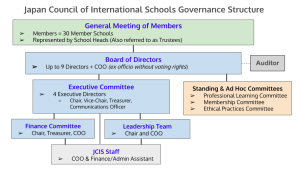
The highest governing body of JCIS is the General Meeting of Members (shain sōkai in Japanese). The General Meeting of Members comprises all Members (member schools) and can make resolutions on matters stipulated in the Act on General Incorporated Associations and General Incorporated Foundations, and matters stipulated in the JCIS Articles of Incorporation. Members are represented by their respective Heads of School, who also serve as Trustees. The Members share governance responsibilities with the Directors, who are subject to the supervision of the General Meeting of Members, with the great majority of day-to-day governance activities being delegated to the Board of Directors, subject to the processes and limitations specified in the Articles of Incorporation.
Article V, Section II: The Board of Trustees
The Board of Trustees shall be formed by the Heads of Schools of all member schools. The Trustees shall share governing responsibilities with the Board of Directors, subject to the processes and limitations explicit in the Articles of Incorporation and this Constitution, which define the manner in which routine governance activity is largely delegated to the Board of Directors, under the oversight of the General Meeting of Members.
Article V, Section III: The Board of Directors
The Board of Directors shall consist of four Executive Directors elected at the Annual General Meeting of Members, up to five Directors appointed from among the Trustees, and the Chief Operating Officer (COO). The COO shall be an ex-officio member of the Board of Directors without voting rights. The Board of Directors is responsible for directing, protecting and enabling the operations of JCIS and is accountable to the General Meeting of Members. In fulfilling its governance role, the Board will focus on fiduciary, strategic, and generative governance that contributes to JCIS’ objectives.
Article V, Section IV: The Executive Committee
The Executive Committee is a subordinate organization of the Board of Directors responsible for the executive functions and responsibilities of JCIS and is composed of four Executive Director positions: Chair, Vice-Chair, Treasurer and Communications Officer. The Executive Committee, under the leadership of the Chair of the Board of Directors, shall make decisions from time to time on behalf of the Board of Directors when it is necessary to do so based on (i) urgency, (ii) confidentiality, or (iii) other compelling and reasonable grounds. In all cases, the Executive Committee shall report such decisions to the Board of Directors and shall be accountable to the Board for decisions made under such circumstances.
Article V, Section V: Chief Operating Officer
Under the leadership of the Chair, the Board of Directors shall appoint a Chief Operating Officer (COO) whose role it is to lead, manage and accomplish the operational work of JCIS in accordance with the strategic direction set by the Board of Directors. The COO shall be a paid position, under terms and conditions established and managed by the Board of Directors.
Article V, Section VI: Auditor
Up to two Auditors shall be appointed by the Annual General Meeting of Members. Auditors may not concurrently serve as directors, trustees or employees of this Association. The role of the Auditor(s) is to help ensure that the Association is operating in accordance with its own governance rules and regulations; attend General Meetings of Members and Board Meetings, and express an opinion when necessary; and notify the Board or General Meeting of Members if becoming aware of any concerns regarding JCIS governance or operations.
Article V, Section VII: Roles of the Executive Committee
The Executive Directors, who form the Executive Committee, shall serve roles as follows:
Chair – shall preside over the business of JCIS, represent JCIS to external parties and be accountable to the General Meeting of Members for governing JCIS in accordance with the objectives and purposes of the organization. The Chair shall oversee the work of the COO, on behalf of the Executive Committee, Board of Directors and wider Board of Trustees.
Vice-Chair – shall support the Chair in their duties and act on behalf of the Chair whenever necessary, serving in the role of Chair in the case that the Chair is unable to fulfil their duties. The Vice-Chair shall oversee the integrity and efficiency of the membership process.
Treasurer – is responsible for reporting on JCIS fiduciary management to the Executive Committee, Board of Directors and General Meeting of Members, and reports on the financial status of JCIS at regular board meetings, as well as General Meetings of Members as necessary.
Communications Officer – shall ensure effective and efficient internal and external communication activities for JCIS. This includes oversight of accurate JCIS membership and activities records and documentation, as well as responsibility to ensure that JCIS is represented appropriately to external audiences through its website and other relevant channels.
Article V, Section VIII: Appointment of Directors and Auditors
JCIS shall have between four and nine Directors and up to two auditors. Directors and auditors shall be appointed by resolution of the Annual General Meeting of Members. In addition to appointing four Executive Directors, the Annual General Meeting of Members may appoint up to five Directors who are recommended by the Board of Directors from among the Trustees (hereinafter referred to as “Recommended Directors”).
Recommended Directors are nominated by a majority vote of the members of the Board of Directors, and the nomination process shall strategically consider the type, size and location of the nominee’s school with respect to maintaining a diversity of board members, as well as the nominee’s potential leadership, initiative and contribution to JCIS projects.
Article V, Section IX: Compensation
All Board of Directors positions, with the exception of the COO, are volunteer and unpaid positions. The Board of Directors may establish procedures for the appropriate reimbursement of expenses for members of the Board of Directors conducting legitimate JCIS business.
Article VI: Limits of Authority
Article VI, Section I: Scope and Limits of Board of Directors Responsibility
The Board of Directors is entrusted and empowered, through its democratic mandate as appointed by the General Meeting of Members, to carry out important governance functions of JCIS. This means it has autonomy to function within the limits defined by the Articles of Incorporation, this Constitution and associated bylaws, in directing, protecting and enabling the work of JCIS. The Board of Directors may, at its discretion, focus on areas that support the purpose and direction of JCIS on issues of relevance to member schools as follows:
- Maintaining membership in a manner that enhances JCIS in fulfilling its objectives and purposes;
- Facilitating professional learning and networking of benefit to international education in the context of Japan;
- Engaging in advocacy for JCIS schools and the cause of international education as appropriate to various audiences and for various purposes both within Japan and beyond;
- Securing and maintaining partnerships, in the form of memoranda of understanding, affiliated consultants, or contracted services that support the objectives and purposes of JCIS;
- Maintaining the integrity and reputation of JCIS through providing challenge and support to member schools in meeting the highest of standards of international education, in line with the criteria for membership;
- Making recommendations to the General Meeting of Members regarding new applications for JCIS membership and the support or potential removal of those who are not fulfilling expectations of membership;
- Overseeing the activities of the COO, which is predominantly the responsibility of the Chair; and
- Any other areas that are aligned to the mission and purpose of JCIS.
Article VI, Section II: Decisions Resting with the General Meeting of Members
The stipulations made in Article VI, Section I notwithstanding, the Board of Directors remains accountable to the General Meeting of Members. The following resolutions shall be made by a majority vote of at least half of all Members and two-thirds or more of the voting rights of all Members.
- Expulsion of Members
- Dismissal of Auditors
- Changes to the Articles of Incorporation
- Dissolution or Continuation
- Other matters stipulated by law
The following actions are subject to a simple majority vote of the General Meeting of Members:
- Approval of new Members
- Election of the Executive Committee
- Appointment of Directors and Auditors
- Changes to the Constitution
- Adoption of the annual year-end financial accounts
The following actions are subject to a process of consultation in which the General Meeting of Members has the right to consider and give input to the Board of Directors before the proposed changes are enacted:
- Any change to the bylaws of JCIS
- Any other planned action which it is reasonable to assume may change the purpose and direction of JCIS
Article VI, Section III: Special Motions
In the case that any Trustee wishes to raise a formal vote of the General Meeting of Members to confirm or challenge any decision of the Board of Directors, or in the case that a Trustee wishes to bring a motion directly to the floor of a General Meeting of Members, the following process is required:
- The Trustee should write a letter to the members of the Executive Committee, with the exception of any member for whom there is a perceived conflict of interest, explaining their intentions, making explicit the decision they wish to bring to the floor and the motion they wish to bring to the General Meeting of Members.
- This letter should be endorsed by at least 15% of the Members, including the Trustee who is putting forth the motion.
In such cases the matter will be brought to the floor at the next General Meeting of Members. The Board of Directors will refrain from any further action on this topic (unless legally necessary or reasonably impractical to delay) pending resolution.
Article VI, Section IV: Votes of No Confidence (Expulsion)
Any member of the Board of Trustees may be removed from their position by a resolution of the General Meeting of Members as per Article VI, Section II. The process for triggering a vote of no confidence shall be as prescribed in Article VI, Section III. Unless a conflict of interest exists, the process of any no confidence vote shall be overseen by the COO.
Article VII: Election, Removal, and Terms of Office for Members of the Board of Directors and Auditor(s)
Article VII, Section I: Nominations Committee
A Nominations Committee shall be established to oversee the election of Executive Directors. The committee shall:
- Be formed of three members of the Board of Trustees, none of whom are intending to run for elected positions on the Executive Committee.
- Be recommended by the Chair of the Board of Directors and be confirmed by a simple majority of the Board of Trustees.
The nominations committee shall be responsible to manage the process of elections at the conclusion of the term of an incumbent Executive Director or upon the resignation or removal from office of a serving Executive Director according to the established procedure as specified in the guidelines for practice within the JCIS Handbook.
Article VII, Section II: Regular Terms of Directors and Auditors
As stipulated in the Articles of Incorporation, the elected Executive Directors serve two-year renewable terms, as do the other Directors of the Board of Directors (up to five) who are appointed by the Annual General Meeting of Members. Auditors (up to two) are appointed by resolution of the Annual General Meeting of Members and serve four-year terms. Terms for Directors and auditors may be renewed indefinitely through election or appointment as appropriate to the position.
Article VII, Section III: Irregular Terms
In the case that a Director or Auditor resigns or is removed from office, the Board of Directors has the authority to appoint an interim officer prior to an election being held at the next General Meeting of Members. The replacement shall serve out the remainder of their predecessor’s term before standing for re-election at the conclusion of that term.
Article VII, Section IV: Removal of Directors or Auditors
Any member of the Board of Directors may be removed from their position by a majority vote of the Board of Directors for any of the following reasons:
- The person is no longer an eligible member of the JCIS Board of Trustees (i.e., no longer Head of School at a JCIS member school )
- The person is no longer physically or mentally able to serve in the position
- Upon the resignation of the member
Auditors may only be dismissed by the General Meeting of Members with a majority vote of at least half of all Members and two-thirds or more of the voting rights of all Members.
ARTICLE VIII: Committees
The Board of Directors may choose to establish committees in order to support the performance of its governance functions. Committees may be either:
- Standing committees serving an ongoing strategic purpose of JCIS. Examples might include committees to govern professional learning or membership.
- Ad hoc committees established to investigate a specific issue or to meet a specific strategic goal.
Committees may include Trustees who are not members of the Board of Directors, as well as other individuals of expertise who can add value to the work of the committee and who are invited to join at the invitation of the Board of Directors or Executive Committee.
ARTICLE IX: Liabilities of Members
No Trustee of JCIS, of any classification whatsoever, shall have any obligation in respect of JCIS’ liabilities.
ARTICLE X: Dissolution or Liquidation
No part of the net income, revenue, and grants of JCIS shall be used for the benefit of any Trustee, Director, officer, or any private individual (except that reasonable compensation may be paid for services rendered in connection with one or more of the purposes), and no Trustee, Director, officer or any private individual shall be entitled to share in the distribution of any part of the assets of JCIS, on its dissolution or liquidation. In the event of such dissolution or liquidation, the assets shall be transferred to an organization listed in Article 5, Item 17 of the Act on Certification of Public Interest Incorporated Associations and Public Interest Incorporated Foundations, for the same charitable and educational purposes as those of JCIS, or they shall be donated to national or local government bodies.
ARTICLE XI: Limits on Amendments to the Constitution
These articles may be amended as prescribed in this constitution, provided however that Article III may not be amended in such a manner as to impair or alter the non-profit, non-political and non-sectarian character of JCIS.